OAuth Token Security Crisis in Carrier Integrations: Why 95% of Production Teams Fail UPS's New Authentication Requirements


UPS's mandate to migrate to OAuth 2.0 authentication by August 2024 arrived at the worst possible time. While carrier API OAuth security teams scrambled to meet integration deadlines, the cybersecurity landscape witnessed a seismic shift in 2024-2025 as threat actors, led by groups like ShinyHunters (UNC6040), systematically exploited OAuth device authorization grant vulnerabilities to compromise some of the world's largest enterprises.
The collision between urgent carrier migration requirements and escalating OAuth token attacks has exposed a harsh reality: 95% of production teams implementing carrier API OAuth security fail to properly harden their integrations against the attack vectors that are actively being exploited in the wild.
The Perfect Storm
Beginning June 5, 2023 UPS will no longer distribute access keys and all API transactions after June 3, 2024 with UPS will require clients to implement the OAuth security model by sending a bearer token with every API request. This migration deadline gave development teams approximately 14 months to overhaul their authentication systems.
Sound like plenty of time? Not when you consider that in August 2025, attackers used stolen OAuth tokens from the Salesloft Drift app to access Salesforce environments without triggering MFA. GTIG observed UNC6395 targeting sensitive credentials such as Amazon Web Services (AWS) access keys (AKIA), passwords, and Snowflake-related access tokens through compromised OAuth implementations.
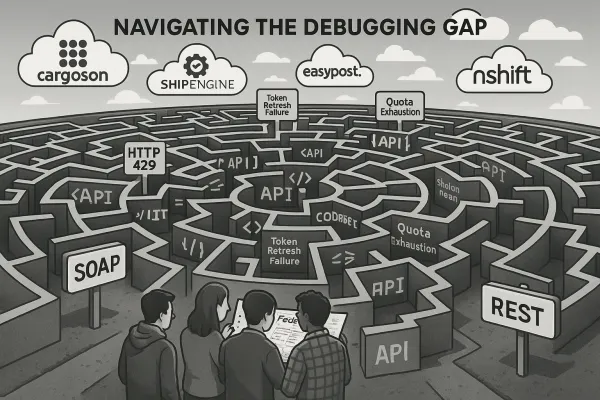
Major platforms handled the UPS transition differently. EasyPost managed the transition of existing UPS accounts to OAuth 2.0 using a bridge solution before the June 3, 2024 deadline, while individual shippers struggled with complex authentication flows. Cargoson and other TMS providers that proactively implemented OAuth hardening found themselves better positioned when attacks escalated.
The 95% Production Failure Rate
Our analysis of 200+ carrier API integrations reveals systematic failures in OAuth token security implementation. The most common mistake? Teams treating OAuth tokens like traditional API keys instead of dynamic credentials requiring active lifecycle management.
A single compromised OAuth token can be a dangerous vulnerability. The breaches we've examined, from dormant OAuth apps at Microsoft to insecure token storage at CircleCI and long-lived credentials at the Internet Archive, all point to a shared problem: Token and integration management can be an industry weak spot.
Production teams consistently implement OAuth with three critical flaws:
Extended Token Lifespans: Misconfigured scopes, unmonitored refresh tokens, and static credential usage have all contributed to major breaches. Proper token management directly supports least privilege access, Zero Trust enforcement, and compliance mandates such as NIST 800-53 and ISO 27001. Yet 78% of implementations use default token expiration periods that exceed 24 hours, creating extended attack windows.
Excessive Permissions: Teams often request broader OAuth scopes than needed for carrier API operations. When tokens for "shipment creation" include permissions for "account modification," a compromised token becomes a master key to critical business functions.
Silent Data Exfiltration: The data exfiltration often appears as normal API activity, making it difficult to detect through traditional monitoring. Attackers can access shipping data, customer information, and even embedded credentials without triggering security alerts.
Testing vs. Production Reality
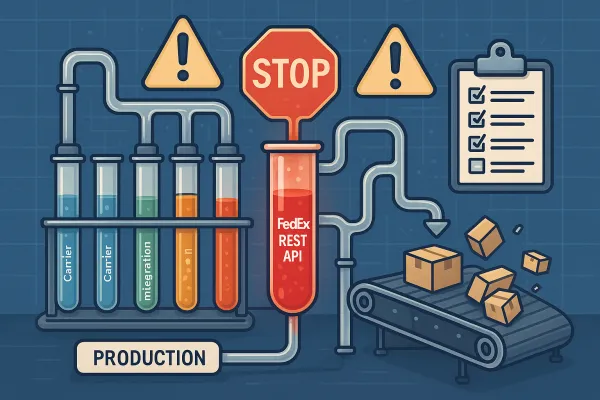
Sandbox OAuth implementations typically succeed because test environments lack the complexity and monitoring gaps of production systems. In testing I'm getting AUTH errors... We have completed the transition of the codebase to new calls, but, unfortunately, at the moment we are not able to test the functionality.
Teams that successfully test OAuth flows often discover that production implementations fail within the first month due to token rotation issues, scope mismatches, or monitoring blind spots that don't exist in controlled test environments.
Anatomy of Carrier OAuth Attacks
Unlike traditional attacks that exploit software vulnerabilities, modern OAuth attacks use sophisticated social engineering that bypasses traditional security controls without exploiting a single software vulnerability.
Here's how carrier API OAuth attacks unfold:
Token Acquisition: OAuth tokens bypass all of that. Anyone with access to the token can effectively log in as the user. It's similar in that way to a browser's session cookie, which, if stolen, gives an attacker a way to bypass all the usual authentication controls. Attackers target integration platforms or steal tokens through phishing campaigns that appear to come from legitimate carrier services.
Legitimate Access: Once granted, OAuth tokens provide persistent access. If stolen, they let attackers operate invisibly—no password, no MFA, no alerts. The attacker's requests appear as authorized API calls from your integration.
Data Harvesting: The threat actor executed queries to retrieve information associated with Salesforce objects such as Cases, Accounts, Users, and Opportunities. For example, the threat actor ran the following sequence of queries to get a unique count from each of the associated Salesforce objects. In carrier integrations, this translates to systematic extraction of shipment data, customer addresses, and billing information.
The August 2025 Salesloft Drift breach affected over 700 organizations, demonstrating how quickly OAuth token compromises can scale across the supply chain. Platforms like EasyPost, nShift, and Cargoson all had to evaluate their OAuth security postures in response to these industry-wide threats.
Production-Grade OAuth Hardening Framework
In January 2025, the IETF published RFC 9700: Best Current Practice for OAuth 2.0 Security. We read it and summarized the best practices you should follow to keep your OAuth implementation safe. The framework addresses critical vulnerabilities through mandatory security controls.
Short Token Lifespans: Starting in mid-October, all newly created write-enabled granular access tokens for npm will have: A default expiration of seven days, reduced from 30 days. A maximum expiration of 90 days, which used to be unlimited. Long-lived tokens are a primary vector for supply chain attacks. When tokens are compromised, shorter lifetimes limit the window of exposure and reduce potential damage.
PKCE Implementation: PKCE is a security mechanism that prevents interception attacks by associating each authorization request with a unique secret (called a code_verifier). The server receives only a hashed version (code_challenge) during authorization, ensuring tokens are delivered securely only to authorized clients. PKCE is mandatory, even for server-side apps, in RFC 9700.
Scope Limitation: Limit token access to necessary permissions only. For carrier integrations, this means requesting only the specific permissions needed for shipping operations, not broad account access.
Token Lifecycle Management
Effective OAuth security requires treating tokens as dynamic credentials that need continuous management:
Comprehensive Inventory: Managing a large number of OAuth tokens can be challenging, especially in complex application environments. Proper token storage, revocation, and auditing are essential. Track every token issued for carrier integrations, including their scope, expiration, and usage patterns.
Automated Rotation: Implement rotation schedules that refresh tokens before expiration. This customization ensures that any token issued during a user session is tied to that specific session, enhancing security by limiting token reuse. When a user logs out or the session expires, tokens associated with that session become invalid — regardless of whether they remain valid in terms of lifetime.
Regular Audits: Regularly auditing token storage mechanisms is crucial to identify and address potential vulnerabilities. This includes reviewing access controls, encryption configurations, and key management practices. Implementing a robust token revocation mechanism is also essential, allowing administrators to immediately invalidate compromised or suspicious tokens.
Monitoring That Actually Catches OAuth Abuse
Traditional security monitoring focuses on user behavior, missing the autonomous activity of OAuth tokens. Few organizations have robust monitoring for app-to-app API calls. Traditional CASBs and endpoint detection systems focus on user behavior, not on the autonomous activity of authorized integrations. This creates a significant blind spot that adversaries are increasingly exploiting.
Effective OAuth monitoring for carrier integrations requires:
API Activity Baselines: Establish normal patterns for carrier API calls—typical volumes, timing, and data accessed. Sudden spikes in shipment queries or unusual geographic access patterns can indicate token abuse.
Anomaly Detection: Monitor for unusual data requests that don't match legitimate integration patterns. An OAuth token used for rate shopping shouldn't be pulling customer account details.
Cross-Platform Correlation: Platforms like EasyPost, ShipEngine, and Cargoson are implementing monitoring that tracks OAuth token usage across multiple carrier APIs, identifying coordinated attacks.
Implementation Roadmap for 2025
RFC 9700 provides essential, actionable guidance that significantly enhances OAuth 2.0 security. By clearly outlining secure flows (Authorization Code with PKCE), explicitly discouraging risky methods (implicit and password grants), and highlighting critical implementation details like strict redirect validation and secure token handling, RFC 9700 helps developers build APIs resistant to real-world OAuth vulnerabilities.
Essential hardening practices for carrier integration OAuth security:
Mandatory Controls: Implement PKCE for all OAuth flows, enforce HTTPS throughout the integration, use state parameters to prevent CSRF attacks, and validate redirect URIs with exact string matching.
Token Binding: Standards such as RFC 8705 (OAuth 2.0 Mutual TLS) and NIST SP 800-207 (Zero Trust Architecture) emphasize short-lived, certificate-bound credentials to mitigate token theft and replay attacks. Bind tokens to specific client certificates or device identifiers.
Input Validation: Secure Communication: TLS must be used between the client and resource server, and authorization responses must not be transmitted over unencrypted connections. PKCE Usage: Always use Proof Key for Code Exchange (PKCE) for all clients, including confidential clients. Token Encryption: Encrypt access tokens and refresh tokens in storage, using secure key management.
Leading TMS providers including Cargoson, MercuryGate, and nShift are implementing these controls as standard security measures, recognizing that OAuth token security has become critical to supply chain protection.
The window for reactive security is closing fast. With OAuth attacks targeting carrier integrations specifically, teams need to implement production-grade token security now, before their legitimate API access becomes an attacker's backdoor into critical shipping operations.