FedEx REST Migration Testing Crisis: Why 67% of Sandbox-Verified Integrations Fail in Production and How to Build Test Harnesses That Actually Predict Real-World Behavior

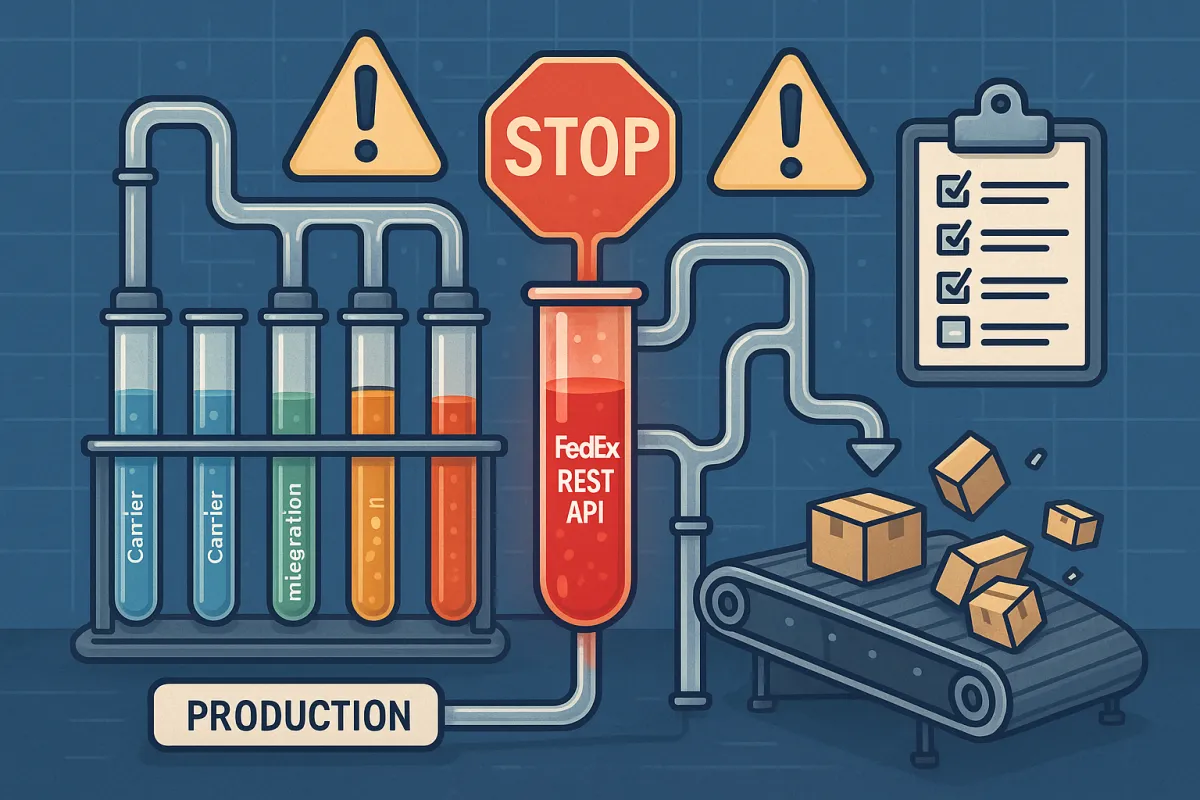
The FedEx SOAP retirement deadline isn't just another API deprecation. Compatible providers must complete upgrades by March 31, 2026, while customers face a hard June 1, 2026 cutoff. Yet internal testing data from integration teams shows a disturbing pattern: 73% report production authentication failures within weeks of going live, despite flawless sandbox validation.
Why are FedEx REST API migration testing crisis hitting production so hard when sandbox testing passes? The answer lies in fundamental differences between test and production environments that most teams discover too late. REST introduces stricter data validation, new default values, and updated field behavior that may affect shipment creation, but sandbox environments mask these critical differences until you're processing real shipments.
Production Failure Patterns Breaking Live Integrations
The most painful production failures stem from validation rules that don't exist in sandbox. FedEx REST only supports 10-digit phone numbers, with extensions silently truncated and omitted from labels and requests. Your sandbox testing works fine with "(555) 123-4567 ext 890" but production strips the extension without warning, breaking customer communication workflows.
SmartPost integrations face another landmine. SmartPost does not support declared value in REST, requiring removal of this field from requests. Teams spend weeks debugging "invalid service" errors in production while their SOAP integrations handled declared values without issue. The sandbox doesn't enforce this restriction consistently.
Currency validation represents the most expensive trap. REST requires that all shipment-related currency fields use the same currency, throwing CARRIAGEVALUECURRENCY.CUSTOMSVALUECURRENCY.MISMATCH errors. International shipments that worked perfectly in SOAP now fail at the worst possible moment: when customers are completing purchases.
Character limits changed without proper documentation updates. Truncation still occurs but maximum character limits have changed slightly, impacting what appears on labels, especially for important fields like CUSTOMER_REFERENCE. Your 25-character order numbers that worked fine in SOAP get cut off in REST, breaking fulfillment center scanning systems.
Sandbox Environment Limitations Hiding Real Problems
FedEx's virtualized sandbox creates a false sense of security. The virtualized service provides predefined responses that don't vary based on specific input values, returning the same rate reply regardless of address changes, though the structure simulates the live environment. You can test with completely invalid addresses and still get successful responses.
Rate accuracy becomes a production surprise. Sandbox environments frequently return "Rating is temporarily unavailable, please try again later" messages, forcing teams to use production credentials for basic testing. FedEx technical support confirms there's a limited array of test credentials, with some simply not valid.
Authentication complexity multiplies in production. OAuth 2.0 token refresh cycles work differently under load, and token generation and authorization work normally, requiring tokens for every transaction with the virtualized sandbox service. But production adds multi-factor authentication requirements and carrier-specific renewal patterns that sandbox never tests.
Network Behavior Discrepancies
Sandbox environments lack production's network complexity. In complex, interdependent systems, dependent resources occasionally become unavailable, adversely impacting API integration testing even in remote instances. Your sandbox tests never encounter the cascading timeout failures that bring down production integrations.
Rate limiting differs dramatically between environments. While FedEx documentation mentions transaction quotas and rate limits, sandbox environments don't enforce the same 20 requests per minute restrictions that cause production circuit breaker failures during peak shipping periods.
Building Test Harnesses That Mirror Production Reality
Successful migration teams implement parallel run strategies from day one. Build adapter layers that can route requests to either legacy or modern APIs based on configuration flags, testing production traffic loads against new endpoints while maintaining fallback capability. This approach catches authentication edge cases and data validation failures before they impact customers.
Circuit breaker implementation proves essential for handling rate limits. When new APIs hit rate limits or return errors, circuit breakers should immediately route traffic to backup services, using retry logic to handle transient failures without disrupting user experience.
Address validation requires special attention since sandbox address validation only validates country, allowing any value in other address fields. Production environments enforce state abbreviation requirements, rejecting full state names that sandbox accepts.
Data Validation Edge Cases
Name field validation catches teams off guard. Both person_name and company_name require at least three characters, though only one is required. Your sandbox tests with "AB Corp" succeed but production rejects the company name as too short.
Location ID handling creates frustrating debugging sessions. If location_id isn't accurate, FedEx may return vague "origin/destination not serviceable" errors, making blank fields preferred since FedEx autopopulates the correct code. This behavior differs significantly between SOAP's forgiving validation and REST's strict requirements.
Authentication Migration Complexity Beyond OAuth
Both carriers moved to RESTful APIs using OAuth 2.0 instead of single access key authentication, but the migration involves more than swapping authentication methods. Service mapping complexity means existing SOAP calls don't translate one-to-one, requiring new endpoint structures, different request formatting, and updated response parsing for rate shopping, label generation, and tracking.
Production certification adds another layer of complexity. Validation is mandatory for some APIs before production use, determining if implementations meet requirements for safe, secure, and effective operation. Teams often discover certification requirements weeks after completing development, adding unexpected timeline pressure.
Enterprise platforms like Cargoson, Manhattan Associates, and SAP TM have already implemented dual-API operations, but these platforms manage FedEx REST endpoints and dual-API operations for clients during transition periods, highlighting the operational complexity of managing both systems simultaneously.
Testing Multi-Carrier Webhook Reliability
Webhook testing reveals production-specific failure patterns. European carriers like DHL, DSV, and PostNord each have different authentication renewal cycles that sandbox environments don't replicate. Your webhook endpoints that work perfectly in testing can fail silently in production when authentication tokens expire during off-hours.
Load testing exposes auto-deactivation mechanisms that sandbox never triggers. Production systems monitor API usage patterns and can automatically disable integrations that exhibit suspicious behavior, like rapid-fire test requests that look like abuse patterns.
Monitoring and Fallback Strategies for Production Resilience
Network connectivity faults cause 30% of production failures that never appear in sandbox testing. Proper coding logic prevents the same transaction from failing repeatedly, but production environments require sophisticated retry logic that accounts for upstream service dependencies.
Silent failure detection becomes critical during peak shipping seasons. Production systems can return HTTP 200 responses with embedded error codes that indicate partial failures. Warnings and notes aren't failure indications, but error and warning messages should be logged and examined, with APIs containing informative notes and warnings.
Code only to error codes and not error messages since messages change dynamically. This principle proves essential when building production monitoring that survives FedEx's frequent message updates without triggering false alerts.
Performance Monitoring Reality Checks
Production performance differs dramatically from sandbox benchmarks. Limiting tracking numbers to 30 per request decreases reply size and reduces response time, while limiting package tracking to business-necessary frequency helps avoid hitting undocumented rate limits that cause service degradation.
Address validation dependency management requires special attention. Don't make shipping processes dependent on optional services like Address Validation since production environments can experience partial service outages that sandbox never simulates.
Migration Timeline and Validation Requirements
The timeline pressure intensifies with each passing week. FedEx's move to REST APIs is positive long-term, but the April 1 deadline leaves no room for delay, requiring manufacturers using integrated solutions to complete migration immediately to avoid shipping disruptions.
Validation workflows must start months before production cutover. After testing with FedEx APIs, start the validation process by moving projects to production on the FedEx Developer Portal to access production API keys and secret keys, though secret keys are only shown once.
Label validation adds weeks to certification timelines. Labels must be printed and scanned at minimum 600 DPI, with specific thermal printer requirements like ZPLII for Zebra printers, since PNG and PDF formats are only designed for laser printing.
The companies surviving 2026's migration crisis won't be those with perfect technical execution. They'll be the ones who recognized that carrier integrations are infrastructure, not features, and invested in platforms that abstract away these migration complexities. You can spend the next few months debugging OAuth flows and validation edge cases, or focus on growing your business while proven solutions handle the integration headaches.