API Versioning Governance Crisis: How to Build Emergency Frameworks That Prevent the 73% Production Failure Rate During 2026 Carrier Migration Deadlines

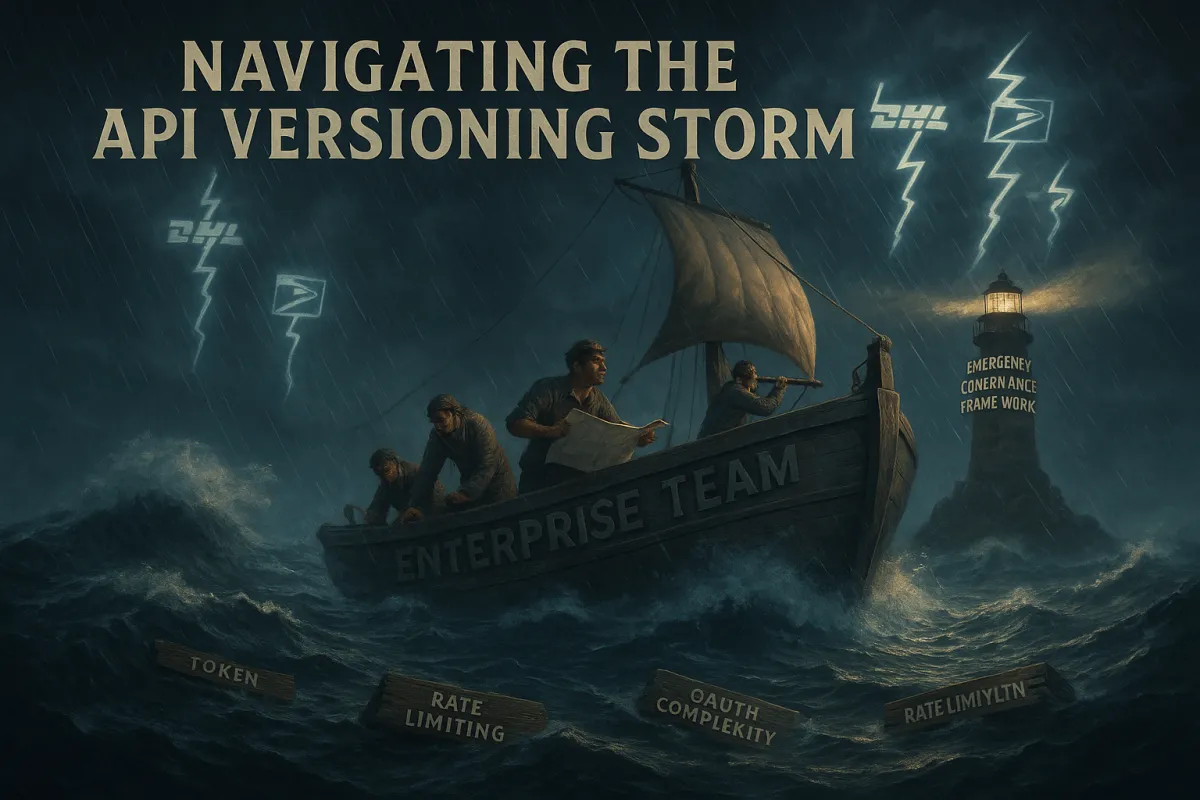
USPS Web Tools shut down on January 25, 2026, and FedEx SOAP endpoints retire on June 1, 2026. 73% of integration teams reported production authentication failures within weeks of carrier API deployments that sailed through sandbox testing. For enterprise teams managing thousands of shipments daily across multiple carriers, this creates a perfect storm: forced migrations under hard deadlines while discovering their API versioning governance has fatal gaps.
This isn't just a technical glitch; it's a systemic governance failure that costs the average organization US$700,000 per year. 75% of production APIs don't match their OpenAPI Specifications. When documentation no longer reflects reality, every API change becomes a potential production incident for every consumer.
The 2026 Carrier API Migration Crisis Is Exposing Fatal Governance Gaps
54% admit they don't even have a consistent versioning strategy across their endpoints. Postman's 2025 State of the API Report found that 60% of teams version their APIs, yet only 26% use semantic versioning and just 17% run contract testing — the gap between intent and discipline is where production incidents live.
The migration pressure is relentless. Compatible Providers: Complete upgrades by March 31, 2026, to allow time for validation, quality checks, and customer communication. Customers: Complete migration by June 1, 2026. USPS's new APIs enforce strict rate limits of approximately 60 requests per hour, down from roughly 6,000 requests per minute without throttling in the legacy system.
Enterprise teams face a governance reckoning across multi-carrier environments. With 82% adopting API-first strategies but only 10% implementing governance frameworks, organizations operate with significant unmanaged risk. Platforms like nShift, EasyPost, and ShipEngine handle some complexity through abstraction layers. Cargoson, along with competitors like MercuryGate and BluJay, built abstraction layers that handle the OAuth complexity, implement intelligent rate limiting queues, and provide fallback mechanisms when USPS quotas are exceeded.
Why 73% of Teams Hit Production Failures Despite Perfect Sandbox Testing
The gap between sandbox testing and production reality has always existed, but with carrier API migrations, it's become a death trap. Data validation failure rates exceeding 5%, critical application functionality being unavailable, or migration downtime surpassing the planned window become rollback triggers that most teams hit within their first month.
OAuth 2.0 token management under load creates different pressures than single-key authentication. Both carriers are moving to a RESTful API using OAuth 2.0 instead of single access key authentication. This isn't just authentication complexity. Your test scenarios used a handful of requests. Production systems generate thousands of concurrent authentication flows, token refreshes, and rate-limited retry patterns that sandbox environments don't replicate.
Rate limiting reality versus documentation creates another trap. Most carrier APIs start degrading at 70-80% of stated rate limits. DHL APIs need 30-60 seconds to stabilize after hitting limits. Your governance framework needs to account for these discrepancies before they become production incidents.
The Hidden Costs of API Versioning Chaos in Multi-Carrier Environments
What's more, costs are only going up. The 2024 API Security Impact Study placed the average cost at US$590,000. IBM's 2025 Cost of a Data Breach Report highlights that outages caused by API mismanagement can cost enterprises up to $200,000 per hour in downtime and recovery.
Carriers are rolling out new API versions faster while shortening migration windows. Even after these migrations are complete, carriers will continue updating pricing logic, delivery data, security requirements, and services. Enterprise TMS platforms like Manhattan Associates, SAP TM, and Cargoson face the same governance challenges as direct integrators — they just handle them at scale for multiple clients.
The rebuild penalty: $64,000 wasted (80% of the build cost that could have been reuse) In organizations with hundreds of microservices, this happens constantly. Teams rebuild payment processing, notification systems, data transformation pipelines, and more—not because they want to, but because they don't know what already exists.
Emergency Governance Framework: The 4-Phase Migration Survival Plan
You can't build comprehensive governance during a crisis migration, but you can establish structural constraints that prevent the worst failure modes. Configure quality gates to fail the build when contract violations are detected. This prevents deploying API changes that break the documented contract.
The key is automated governance checks inside CI/CD pipelines. Configure CI/CD quality gates to fail builds when contract violations are detected. No broken contracts reach production. OpenAPI diff steps that detect breaking changes turn governance from a review process into a structural constraint.
Phase 1: Rapid Inventory and Baseline Assessment (Week 1)
Start with an API inventory that identifies every system touching USPS Web Tools or FedEx SOAP. Map every system that touches USPS Web Tools or FedEx SOAP. Include your ERP, WMS, TMS, and any custom applications that handle shipping data.
Single API registry becomes your source of truth. Every endpoint, every version, every consumer relationship needs visibility. 75% of production APIs don't match their OpenAPI Specifications. The immediate priority isn't fixing the gaps — it's knowing where they are.
Create spec validation automation that runs against every repository. Tools like Redocly CLI or Spectral can validate OpenAPI specifications and catch drift before it compounds. The goal isn't perfect documentation; it's preventing undocumented breaking changes from reaching production.
Phase 2: Breaking Change Detection Automation (Week 2)
OpenAPI diff steps that compare current versus proposed specs catch breaking changes in pull requests. Running fern diff in CI detects breaking changes before they reach consumers, failing the build if backward compatibility breaks. Tools like oasdiff analyze specification changes and flag removals, renames, or type changes.
Schema validation against pull requests prevents contract violations. Fail the build if a PR removes a field or changes a type in your public API spec. Use code-first spec generation (e.g., TypeSpec, Zod-to-OpenAPI) to prevent spec drift from code. Every code change that affects API structure triggers automated contract validation.
Linting for naming inconsistencies and response structure changes creates consistency across teams. The validation runs in seconds, but catches changes that would cause hours of debugging in production.
Phase 3: Contract-Driven Development Implementation (Week 3-4)
This allows us to avoid breaking changes when multiple consumer applications depend on the shared API, extending the API according to the consumer's needs through CDCs. Consumer-driven contracts eliminate the gaps where drift happens most.
The pattern works through contract artifacts stored in a central broker. Consumer (service calling API) defines contract: "I call GET /users/123, I expect response with fields id, name, email in JSON format." This contract is saved in formal format. Contract is stored (in Pact Broker or similar) and available to provider.
Automated deployment gates prevent contract violations from reaching production. API contract tests should run on every pull request that touches API code on either side of the contract. Breakages surface within minutes of being introduced. Contract verification becomes a required CI check, not a manual review step.
Production-Grade Validation That Actually Predicts Carrier API Reality
Carrier APIs behave differently than their documentation suggests. Rate limit discrepancies of 30-70% between documented limits and actual performance are common. Most carrier APIs start degrading at 70-80% of stated rate limits, not at 100%.
DHL APIs require 30-60 seconds to stabilize after hitting limits. FedEx OAuth token refresh under load creates different error patterns than single requests. UPS migrated to OAuth 2.0 in August 2025. The production behaviors aren't documented anywhere — you discover them when your integration fails.
Building Test Harnesses That Bridge the Sandbox Reality Gap
Standard testing tools like Postman don't replicate the burst patterns, concurrent connections, and payload variations that happen in production. You need test harnesses that simulate realistic traffic patterns against carrier APIs.
Stack-in-a-box setup eliminates variables that distort results. Consistent AWS regions, predictable network latency, and isolated test environments remove the noise that makes carrier API behavior unpredictable. API tests execute 10-50x faster than equivalent UI tests because they skip browser rendering, DOM manipulation, and network round-trips to load assets, according to TotalShiftLeft (2026). This speed advantage makes API-layer testing the highest-value investment for teams adopting shift-left practices.
Platforms like EasyPost, nShift, and Cargoson handle this complexity by implementing sophisticated rate limit management and retry logic. They absorb the carrier API volatility so your integration doesn't have to.
Measuring Governance Success: KPIs That Actually Matter During Crisis Migrations
Coverage measures what percentage of your API surface has contracts and breaking change detection. With 82% adopting API-first strategies but only 10% implementing governance frameworks, organizations operate with significant unmanaged risk. The target isn't 100% coverage immediately — it's identifying which 20% of APIs cause 80% of integration failures.
Conformance tracks how often APIs match their documented contracts. 75% of production APIs don't match their OpenAPI Specifications. Improvement here means fewer surprise breaking changes and faster integration debugging.
Change safety measures time from "breaking change detected" to "issue resolved." Breakages surface within minutes of being introduced. An API contract testing suite that runs nightly loses most of its value because the feedback loop is too slow to change behaviour at the point of development.
Operational health includes median time from "I need an API for X" to first successful call. Developer experience metrics track violation suppression versus fixes — are teams bypassing governance controls or improving API quality?
During carrier migrations, these KPIs predict which teams will hit the 73% production failure rate and which will successfully navigate the transition. The difference isn't perfect planning — it's having structural constraints that catch problems before they become production incidents.