API-First Design Meets Reality: Why 80% of Carrier Integration Tests Fail Despite Perfect Documentation

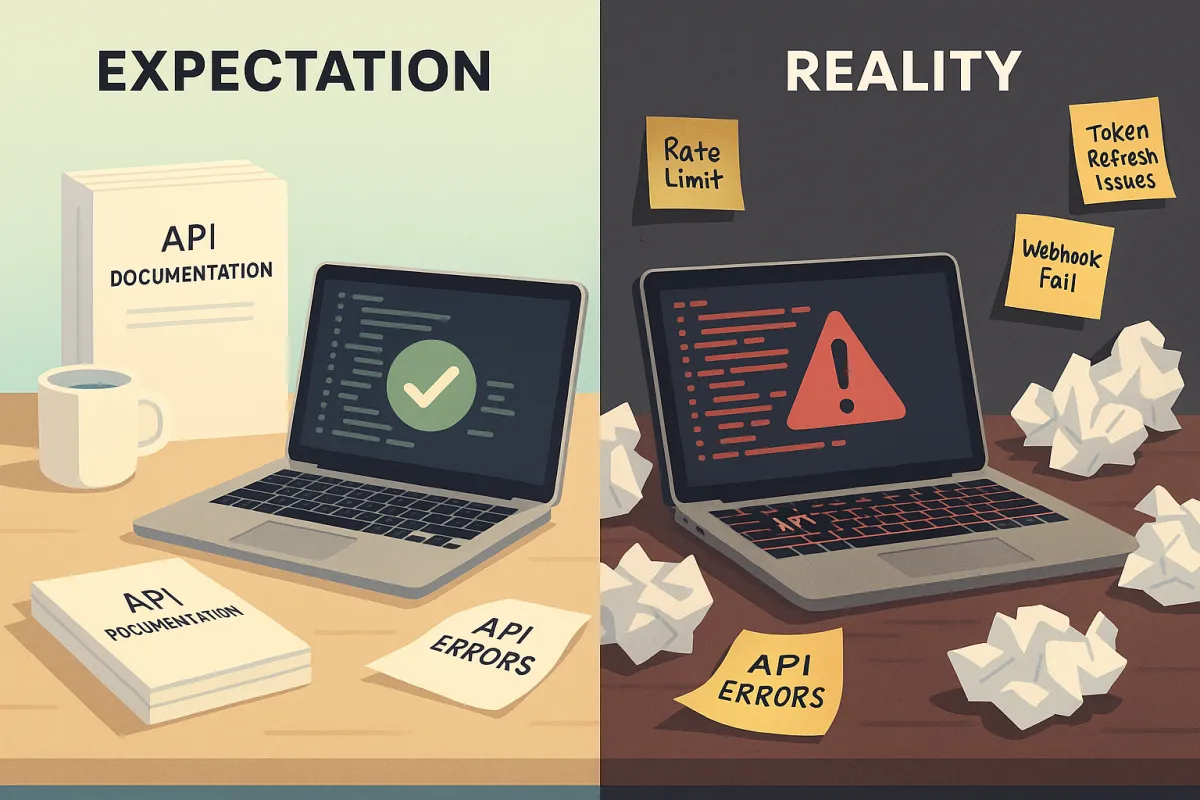
API-first design promised to solve integration headaches by designing APIs before building applications. Companies are investing heavily in this approach for 2025, expecting better developer experience and faster integrations. Yet 80% of carrier integration tests still fail during initial implementation, despite documentation that looks perfect on paper.
The problem isn't the concept. It's that API first testing requires fundamentally different validation methods than traditional software testing, especially in the complex world of shipping APIs.
The API-First Promise vs. Integration Reality
Major platforms like nShift, EasyPost, and Cargoson have embraced API-first design. Their documentation showcases clean endpoints, consistent response formats, and comprehensive SDK support. The theory sounds solid: design the API contract first, then build everything around it.
But here's what happens in practice. Your team spends two weeks studying the docs, writes comprehensive unit tests that pass beautifully, then hits production and watches everything break in creative ways the documentation never mentioned.
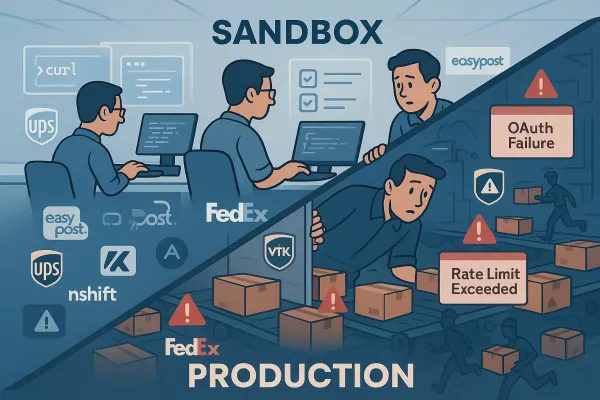
Take FedEx's Web Services API. The authentication flow looks straightforward in their sandbox: grab a token, make your calls, refresh when needed. Simple. Until you discover that production token lifecycles behave differently, rate limits kick in during batch processing, and webhook signatures use a different algorithm than documented.
The Hidden Testing Gap in API-First Carrier Platforms
Traditional testing assumes you control both sides of the conversation. With carrier integration validation, you're testing against external systems with their own quirks, maintenance windows, and undocumented behaviors.
API testing faces unique challenges that documentation can't capture. OAuth flows work fine with Postman but fail when your system needs to refresh tokens automatically. Rate limiting documentation says "1000 calls per hour" but doesn't mention that address validation calls count triple during peak season.
The average integration timeline for new shipping carriers has stretched to 3 months, despite API-first promises of plug-and-play connectivity. The gap isn't in the API design—it's in how teams validate these integrations.
Real-World Failure Patterns We've Observed
DHL's API documentation shows clean JSON responses for tracking calls. What it doesn't mention: tracking numbers with leading zeros get normalized differently in sandbox versus production, breaking your parsing logic.
UPS webhook authentication works perfectly during testing. Then production webhooks start failing because their IP whitelist requirements aren't mentioned in the integration guide. Your monitoring shows "200 OK" responses, but the webhooks never reach your application.
GLS address validation accepts malformed postal codes during testing but rejects them when generating actual labels. The error message? "Invalid request format"—helpful as always.
These aren't edge cases. They're predictable patterns that traditional validation methods miss because they focus on happy-path scenarios instead of the messy reality of multi-carrier environments.
The Authentication Testing Maze
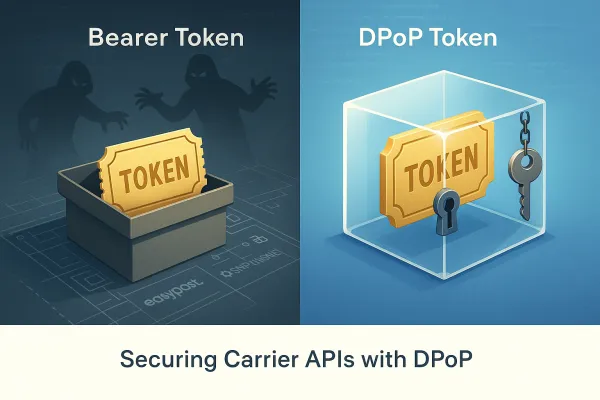
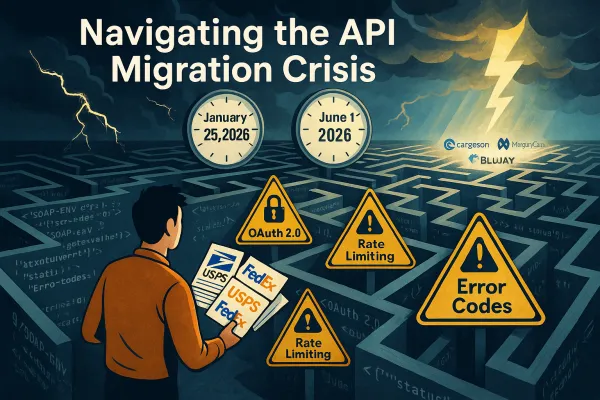
API security testing has become more complex as carriers adopt sophisticated authentication schemes. OAuth 2.0, JWT tokens, API key rotation, and multi-tenant access controls create a web of dependencies that single-endpoint testing can't validate.
EasyPost uses straightforward API key authentication—until you need to implement their webhook signature verification. The documentation shows a basic HMAC example, but production webhooks include additional headers that change the signature calculation.
nShift's OAuth implementation requires browser redirects for initial setup. Testing this in a headless CI/CD pipeline requires workarounds that the documentation doesn't address. Your integration works fine locally but fails during automated deployment.
Cargoson handles multi-tenant scenarios where test accounts behave differently from production multi-user setups. Rate limits apply per tenant, not per API key, creating testing scenarios that sandbox environments can't replicate accurately.
Beyond Unit Tests: Integration-First Validation Strategy
Effective shipping API testing requires treating the integration as a black box with multiple moving parts. Instead of testing individual endpoints, you need to validate complete workflows under realistic conditions.
Start with end-to-end scenarios: request shipping rates, book the selected service, generate labels, submit tracking requests, and verify webhook delivery. Each step depends on the previous one, creating compound failure points that unit tests miss.
Environment parity becomes crucial. Sandbox APIs often use simplified validation logic, mock data, or relaxed rate limits. Production environments enforce stricter rules, use real address databases, and implement anti-fraud measures that sandbox testing never reveals.
Load testing with realistic shipping volumes exposes problems that single-call testing misses. Batch label generation might work fine for 10 packages but start failing at 100 due to undocumented timeouts or memory constraints on the carrier's side.
Tools and Frameworks That Actually Work
Contract testing with Pact helps validate API compatibility, but shipping APIs need specialized tools for their unique challenges. Custom test harnesses that manage token lifecycle, simulate webhook delays, and handle carrier-specific edge cases prove more valuable than generic API testing frameworks.
Monitoring-driven testing in production catches issues that pre-deployment testing misses. Set up synthetic transactions that exercise your full integration stack continuously, alerting when response times increase or error rates spike.
Webhook reliability testing requires dedicated infrastructure. Carriers like DSV and DB Schenker sometimes deliver webhooks minutes or hours after the actual event. Your testing needs to account for these delays and verify that your system handles duplicate or out-of-order notifications correctly.
The Developer Experience Reality Check
Companies are investing heavily in API developer experience, but good DX for carrier integrations means more than clean documentation. It means providing testing tools that mirror production behavior, comprehensive error catalogs, and honest guidance about integration complexity.
FedEx's developer portal includes detailed payload examples but lacks guidance on handling their various service disruption scenarios. UPS provides excellent SDK documentation but minimal information about webhook retry logic or failure handling.
The best platforms acknowledge integration complexity upfront. They provide testing credentials that behave like production accounts, detailed error response catalogs, and realistic timeline expectations for different integration scenarios.
Building Validation Into API-First Design
The API market continues expanding rapidly, with AI-powered monitoring becoming standard for processing traffic in real-time. But automated monitoring only helps if your initial integration validation catches the problems that matter.
Design your validation pipeline to treat external API dependencies as unreliable by default. Test token expiration scenarios, verify webhook signature algorithms in production, and validate address handling with real international addresses that expose normalization differences.
Synthetic test data has limits. Carrier APIs validate addresses against real databases, check service availability for actual postal codes, and enforce business rules that synthetic data can't trigger. Include real-world address samples, actual product dimensions, and valid tracking numbers in your test datasets.
The goal isn't perfect test coverage—it's building confidence that your integration won't fail in embarrassing ways when handling actual shipping requests. Focus validation efforts on the failure modes that hurt customer experience most: incorrect shipping costs, failed label generation, and missing tracking updates.
API-first design works, but only when your validation strategy acknowledges that external integrations bring complexity that traditional testing methods can't handle. Build your testing around real workflows, expect documentation gaps, and design for the failure scenarios that matter most to your users.